Your affiliate terms are only as good as what you can see
The agreement says what partners may and may not do with your brand. Serpward shows what they are actually doing — in every country, language and device you sell in — and tells apart the partners you licensed from everyone else ranking on your name.
The terms are written. The checking is not.
Programmes forbid much the same handful of things: ranking on the brand name, republishing product material, presenting yourself as the company. The terms are agreed, and then nobody looks — because looking means running your own brand searches in every market, on every device, and knowing by heart which of the results belong to whom.
So a breach is found late and by accident. Meanwhile the programme keeps paying for visitors who typed the brand name into the search box and would have arrived anyway.
Four steps, repeated for as long as the programme runs
You list your brand terms, your markets and your partners
The searches people use to find you; the countries, languages and devices that matter; and the domains allowed to carry your material — your own sites and every licensed partner. That list is what makes the rest meaningful: without it, every result in the page looks the same.
The results are collected again and again
Each search is re-run on its own schedule, market by market. A page that ranks in one country and nowhere else does not show up in a single check made from one desk.
Anything outside your list is recorded
The page is opened and captured: a screenshot as it appeared, the passages that match your material, and a check for content shown to the search engine but withheld from the visitor. Recorded first, because a page edited afterwards cannot be captured as it was.
You decide: a conversation or a notice
Some of what turns up is a partner who has drifted outside the terms — that is a conversation, and it goes better with the evidence attached. Some of it is nobody you have ever heard of — that is a takedown notice, with the same evidence attached.
Evidence is what turns a policy into something you can act on
A partner told they are in breach will ask what exactly was seen, and when. A host asked to remove a page will refuse a claim they cannot check. Both need the same thing: the page as it appeared, the passages that match your material, the market it was found in, and the time all of it was recorded.
The record is taken at the moment the page is found, not when the letter is written. Pages get edited once someone starts asking about them.
Official Brand Name — everything you get on the official site, plus our own offer on top.
Sign in or create an account.
Brand Name terms and conditions copied in full, with a different link at the end.
A partner ranks in one market, not in all of them
Someone bidding for your brand in one country, in one language, on phones only, is invisible to a single check made from head office. Monitoring is set per combination, which is also how the results themselves work.
Country
The results in Germany are not the results in Kazakhstan. Each country is watched on its own.
Language
The same country returns different pages in different languages, and a partner usually works in one of them.
Device
A page that ranks on a phone may be absent on a desktop. Both are checked.
Over time
Positions are kept, not just noted: when a page appeared, how long it held, whether it came back.
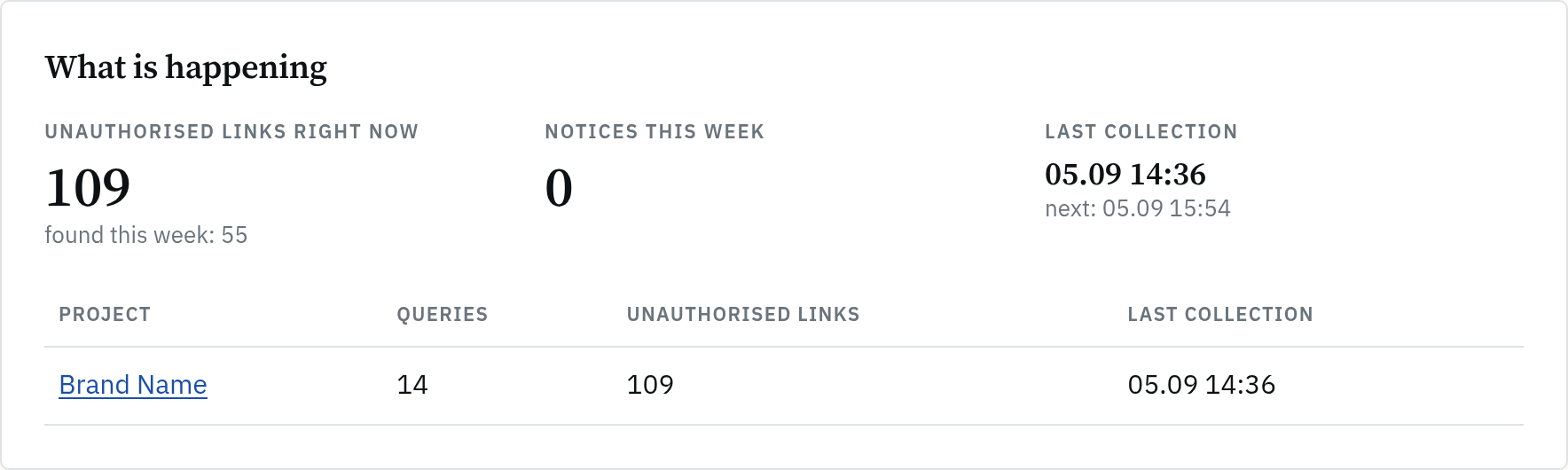
You need this if any of the following is true
You cannot say who ranks on your brand right now
The question is simple and the honest answer is that nobody on the team knows, because nobody has looked at every market this week.
Partners have drifted outside the terms
What was agreed at signing and what is live two years later are different things, and nothing in the programme reports the difference.
You are paying for traffic that was already yours
Visitors who typed the brand name into the search box are attributed to a partner who intercepted them on the way in.
Someone is presenting themselves as you
A page uses your name, your text and your images in a way that reads as official, and it is not.
You run the programme in several countries
Terms are enforced where somebody happens to look, which in practice means one or two markets out of a dozen.
A page shows the reviewer nothing
You reported a page, were told there was nothing on it, and suspected it shows one thing to the search engine and another to whoever opens the link.
The number comes after the first search, not before it
There is no self-serve plan. What the work costs depends on how many queries and markets need watching and how much is already out there — and neither of us knows that until we look. The first search costs you nothing.
What counts as a breach?
Your agreement decides that, not us. What is reported is factual: this page ranks for this search, in this market, it carries this much of your material, and it belongs to a domain that is not on your list. Whether that breaches your terms is a reading of your terms.
Do you watch paid ads as well?
No. This is the organic results — the listings below the ads. Watching bought placements is a different job with different tooling, and saying otherwise would be easy and wrong.
How do you tell my partners apart from strangers?
You give us the list: your own domains and every partner licensed to carry your material. Everything on it is excluded before anything is reported, however often it appears.
What if a partner uses a domain we have never seen?
Then it appears as unlisted, which is precisely the finding. Whether it turns out to be a partner working through a domain they never declared, or somebody unrelated, is answered by asking — with the record in hand.
Can you get a page removed, or only report it?
Notices are filed, with the evidence attached, through a real browser rather than an interface that no longer accepts machines. Whether the page comes down is the host’s decision — which is why the search keeps running afterwards and the position is checked again.
Do you need access to our affiliate platform?
No. Everything here is done from the outside, from the search results themselves. What is needed from you is the list of brand terms, the markets, and who your partners are.
Start with a look at your own programme
Tell us the brand, the markets that matter, and who your licensed partners are. We run the search and send you the list of what is ranking and who it belongs to, before anything is agreed.